AI Agents for ACCESS Success
Help your patients hit their health targets. Get paid for outcomes. OpenHealth provides the AI infrastructure.
CMS is changing how chronic care gets paid
The ACCESS Model launches July 2026 with a simple premise: get paid for outcomes, not activities.
For organizations managing Medicare patients with hypertension, diabetes, chronic pain, or depression, this is a massive opportunity—recurring Outcome-Aligned Payments tied to measurable health improvements.
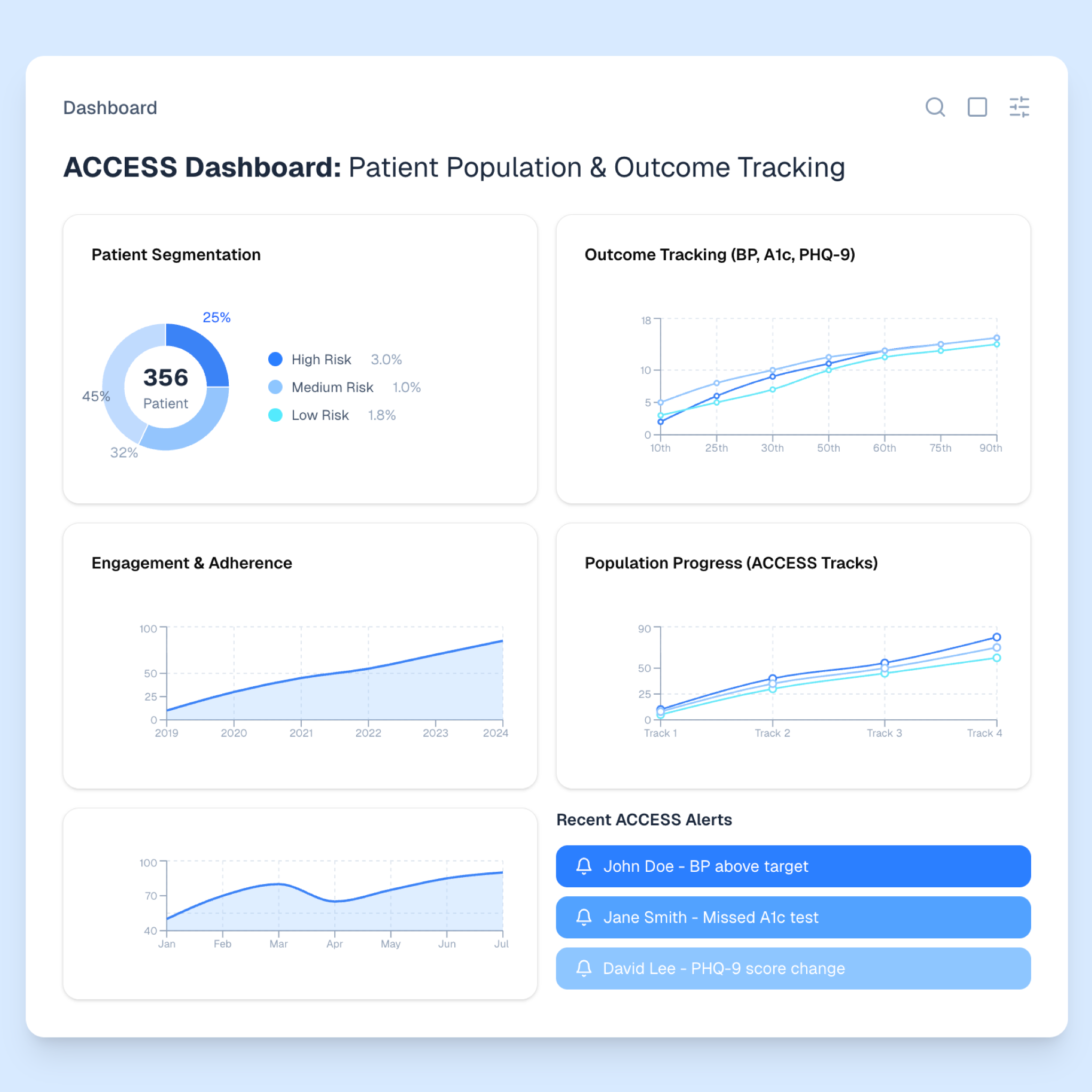
But there's a catch: you need the technology infrastructure to identify eligible patients, track outcomes across your population, and actually move the needle on BP, A1c, and PRO scores.
That's where OpenHealth comes in.
Pays for visits, procedures, and activities regardless of patient outcomes.
Pays for measurable outcomes—BP control, A1c targets, improved PRO scores.
OpenHealth bridges the gap.
ACCESS in 60 Seconds
ACCESS (Advancing Chronic Care with Effective, Scalable Solutions) is a new CMS Innovation Center model testing outcome-based payments for technology-supported chronic care.
10-Year Model
Starting July 2026
Outcome Payments
Tied to measurable results
40M+ Beneficiaries
Medicare patients eligible
4 Clinical Tracks
CKM, eCKM, BH, MSK
Four Tracks. One Platform.
ACCESS focuses on conditions affecting two-thirds of Medicare beneficiaries. OpenHealth supports all four tracks with AI-driven identification, care gap detection, and outcome tracking.
Track 1: eCKM
Early Cardio-Kidney-Metabolic
How OpenHealth Helps:
- Identifies patients with uncontrolled BP or trending risk factors
- Flags medication optimization opportunities
- Generates patient communications for lifestyle modification
- Tracks population-level progress toward BP and lipid targets
Track 2: CKM
Cardio-Kidney-Metabolic
How OpenHealth Helps:
- Lab Results Agent parses labs to identify patients off A1c or eGFR targets
- Recommends guideline-concordant medication adjustments
- EHR Analysis Agent prioritizes patients at highest risk
- Drafts care plan updates for PCP coordination
Track 3: BH
Behavioral Health
How OpenHealth Helps:
- Integrates PRO capture into patient workflows
- Flags patients with worsening symptom trajectories
- Surfaces patients needing escalation or care coordination
- Generates clinician summaries of behavioral health status
Track 4: MSK
Musculoskeletal
How OpenHealth Helps:
- Tracks pain and function scores over time
- Identifies patients responding (or not) to current interventions
- Supports opioid-sparing outcome documentation
- Flags patients ready for graduation vs. needing intensification
Your Agents, ACCESS-Ready
The same AI agents trusted by health systems and EHR platforms—now configured for ACCESS outcome tracking and reporting.
EHR Analysis Agent
Analyzes labs, patient histories, and generates clinical write-ups.
For ACCESS: Identifies ACCESS-eligible patients, assigns tracks, stratifies by risk of missing outcome targets.
Lab Results Agent
Embeds into EMR workflows to interpret new labs and draft patient letters.
For ACCESS: Flags patients off BP, A1c, lipid, or eGFR targets. Drafts care gap alerts and clinician summaries.
Insights Agent
Surfaces patients who should undergo specific tests or learn about relevant medications.
For ACCESS: Proactively identifies care gaps that, if closed, move outcome metrics. Prioritizes intervention opportunities.
Patient Communication Agent
Generates personalized, evidence-based health summaries patients can understand.
For ACCESS: Creates adherence nudges, lifestyle coaching messages, and appointment reminders aligned with track goals.
The AI Engine Behind Your ACCESS Program
OpenHealth isn't another EHR module or generic dashboard. It's an AI engine purpose-built to help you hit the outcome thresholds that determine your payment.
Identify
Automatically identify ACCESS-eligible patients and assign them to the right track.
Stratify
Prioritize patients by likelihood of missing outcome targets.
Detect
Surface missing labs, suboptimal medications, overdue screenings.
Recommend
AI-generated, guideline-concordant next steps for clinician review.
Engage
Personalized patient communications for adherence and lifestyle.
Track
Real-time visibility into population-level outcome achievement.
Why OpenHealth
Every chronic care platform claims to improve outcomes. We prove it.
Evidence-Based Insights
Every recommendation grounded in peer-reviewed research from PubMed and validated by practicing physicians. Not generic AI—clinical AI.
Validated Performance
In blinded physician evaluations, OpenHealth outperforms general-purpose AI on clinical reasoning, care gap identification, and recommendation quality.
Built for ACCESS
We're not retrofitting an existing platform. OpenHealth is purpose-built for the outcome measures, reporting requirements, and clinical workflows ACCESS demands.
From Zero to ACCESS-Ready
Connect Your Data
We integrate with your EHR via FHIR APIs. No rip-and-replace.
Identify Your Population
OpenHealth scans your patient population and surfaces ACCESS-eligible patients by track.
Configure Your Workflows
Set escalation rules, clinician assignments, and engagement preferences.
Go Live
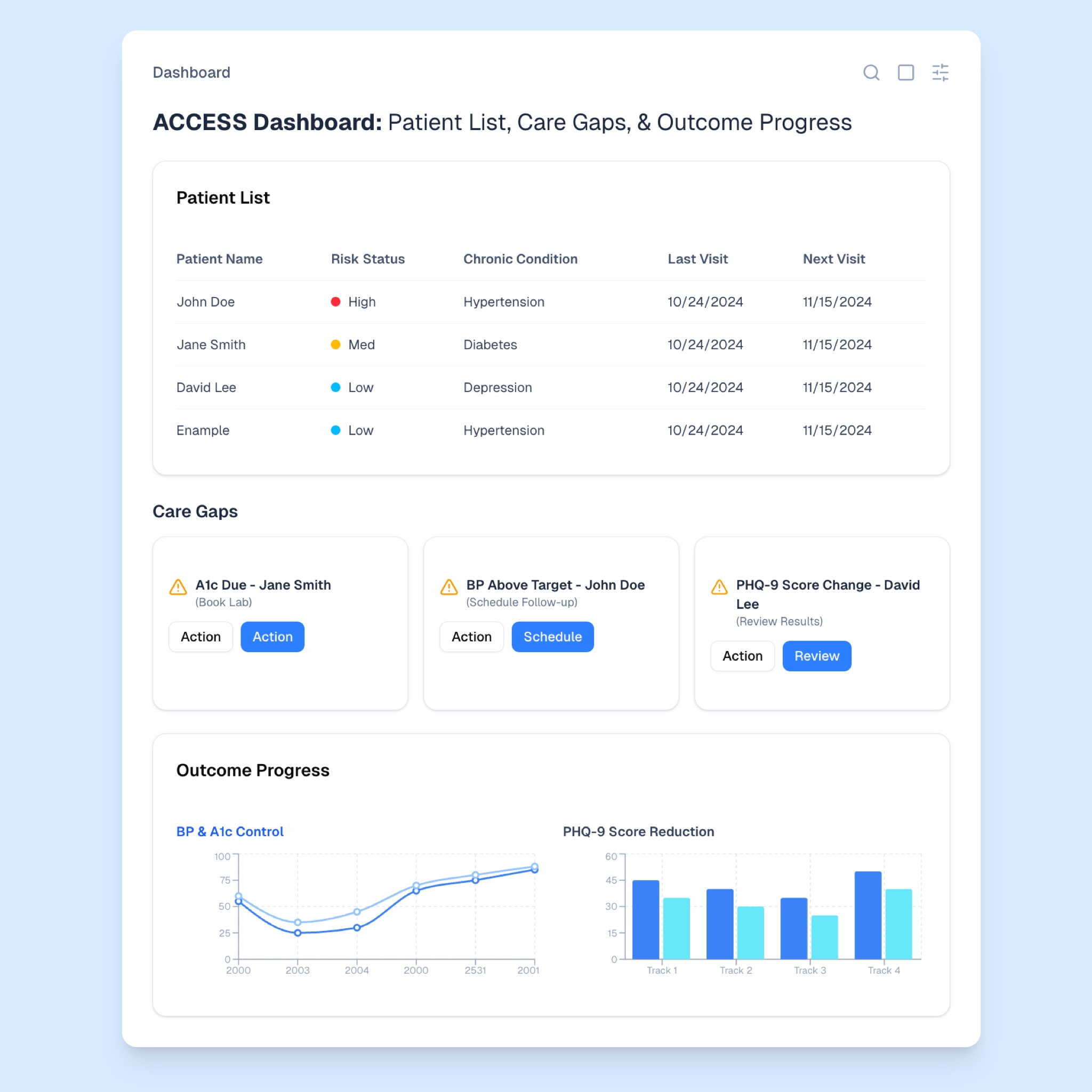
Your clinicians see prioritized patient lists, care gaps, and AI-drafted recommendations from day one.
Track and Improve
Real-time outcome dashboards show your progress. OpenHealth learns what works for your population.
See It In Action
Your clinicians get a single view of their ACCESS panel: who needs attention, what gaps to close, and whether the population is on track.
Built For Organizations Going After ACCESS
Health Systems & Clinics
You have the patients. You need the infrastructure to track outcomes and hit thresholds at scale. OpenHealth integrates with your existing workflows.
EHR & Telehealth Platforms
Embed ACCESS-ready AI agents directly into your platform. Differentiate your offering for customers pursuing ACCESS participation.
Payers & Insurance
ACCESS complements your existing value-based arrangements. Stratify risk, identify care gaps, and track outcomes across your Medicare population.
Digital Health Companies
You have the app or device. OpenHealth provides the clinical AI layer that turns engagement into measured outcomes CMS will pay for.
Enterprise-Grade Security for ACCESS
ACCESS requires HIPAA compliance and secure data exchange. OpenHealth is built for it.
HIPAA Compliant
Full compliance with all HIPAA Privacy and Security Rules
BAA Available
Business Associate Agreements for all enterprise customers
SOC 2 Type II
Audited security controls and data protection practices
End-to-End Encryption
Data encrypted in transit and at rest with AES-256
HIPAA
Compliant
SOC 2
Type II
BAA
Ready
AES-256
Encryption
The Clock Is Ticking
ACCESS applications for the July 2026 cohort are due by April 1, 2026. Organizations making technology decisions now will have the advantage.
Don't wait. Get ACCESS-ready now.
Request a DemoFrequently Asked Questions
Do we need to be enrolled in Medicare Part B to use OpenHealth?
Does OpenHealth replace our EHR?
What if we only want to participate in one or two tracks?
How is OpenHealth priced?
Can OpenHealth help us with the ACCESS application?
What if CMS hasn't released OAP payment amounts yet?
Ready to Get ACCESS-Ready?
The organizations that move now will define the ACCESS ecosystem. Let's talk about how OpenHealth can be your outcomes engine.
Questions? Contact us at access@openhealth.com
OpenHealth is a technology platform provider. Participation in the CMS ACCESS Model requires separate application to and approval by CMS. OpenHealth does not guarantee ACCESS acceptance or outcome achievement. ACCESS Model details are subject to change pending final CMS guidance.